
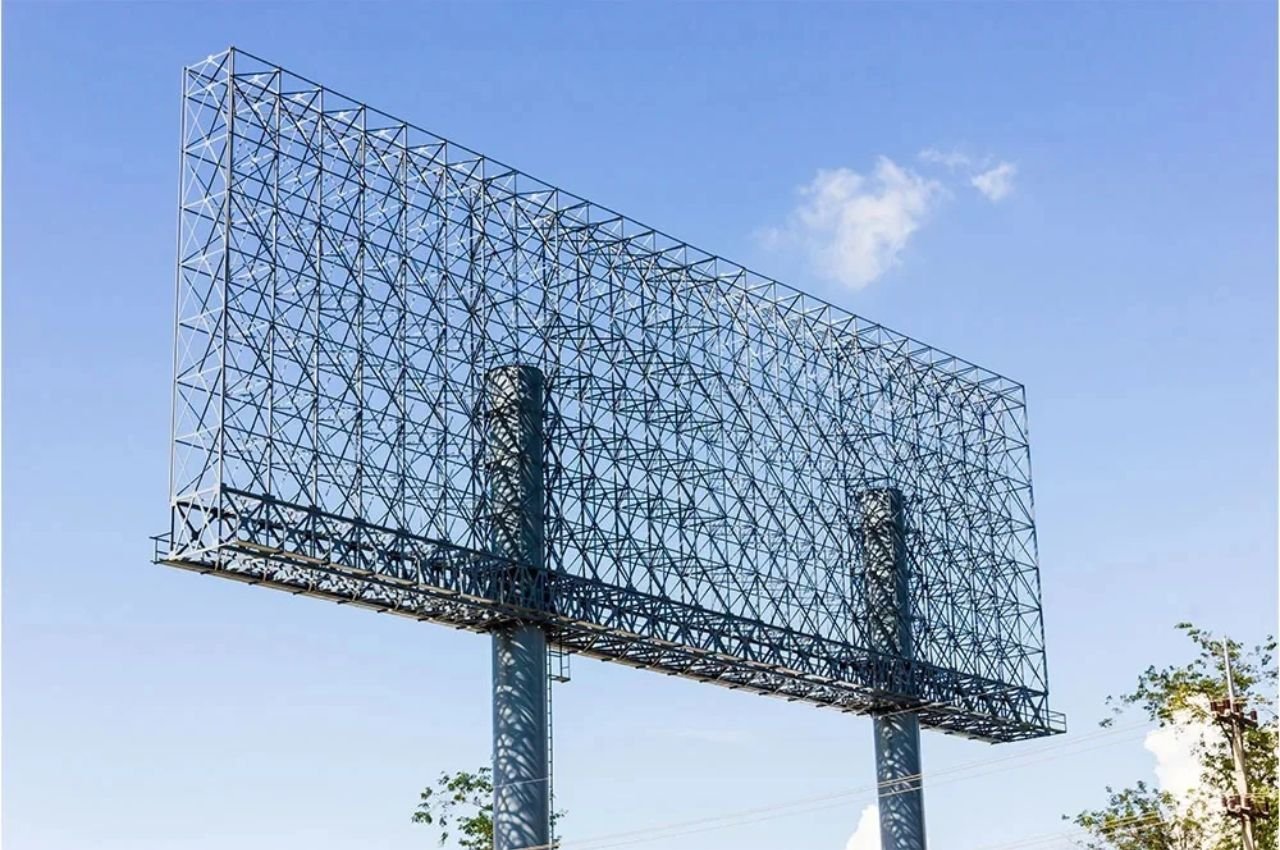
Outdoor billboards are exposed to changing weather conditions throughout their service life. Rain, humidity, wind loads, temperature variations and airborne contaminants can all affect the durability and performance of the materials used in their construction.
For billboard manufacturers, selecting the right steel is therefore an important part of achieving corrosion resistance, structural stability and reliable fabrication performance.
Alu-Zinc Coated Steel combines the strength of a steel substrate with the protective properties of an aluminium-zinc alloy coating. This makes it a practical material option for billboard back panels and other outdoor applications.
However, material selection involves more than choosing a corrosion-resistant coating. Factors such as coating weight, sheet thickness, panel dimensions, fabrication methods and installation conditions must also be considered.
Understanding how these specifications work together can help manufacturers select suitable materials and produce durable billboard panels.
Corrosion is a major consideration for steel components used in outdoor structures. Billboard back panels may be exposed to rain, moisture, temperature fluctuations and atmospheric contaminants over extended periods. Without suitable protection, these conditions can contribute to rust formation, surface deterioration and increased maintenance requirements.
Alu-Zinc Coated Steel addresses these challenges through a metallic coating that combines aluminium, zinc and silicon. A commonly used 55% aluminium-zinc coating composition contains approximately 55% aluminium, 43.4% zinc and 1.6% silicon by weight.
Aluminium contributes to the formation of a protective surface layer that helps limit the steel substrate’s exposure to moisture, oxygen and other corrosive elements.
This barrier effect is particularly useful for large panel surfaces exposed to outdoor conditions.
Zinc contributes galvanic protection at exposed areas, including certain scratches and cut edges. Because zinc is more electrochemically active than steel, it can corrode preferentially and help protect the underlying substrate.
However, the extent of this protection depends on coating composition, exposure conditions and the nature of the exposed area.
Silicon helps control reactions between the molten aluminium-zinc coating and the steel substrate during the hot-dip coating process. This supports the formation of a suitable interfacial layer and contributes to coating adhesion.
Together, these elements provide a combination of barrier and sacrificial protection that supports the use of Alu-Zinc Coated Steel in outdoor applications.
However, corrosion performance also depends on coating weight, surface condition, fabrication quality and the environment in which the billboard is installed.
The suitability of Alu-Zinc Coated Steel depends on several interconnected material and fabrication requirements.
Coating weight refers to the total mass of metallic coating applied to the steel sheet, generally expressed in grams per square metre. It is an important specification when evaluating corrosion protection.
In general, a higher coating weight can provide a greater reserve of protective material, although actual performance depends on the exposure environment and coating characteristics.
Manufacturers should select an appropriate coating specification based on the intended application, expected service conditions and relevant project requirements.
The thickness of the steel substrate influences panel stiffness, resistance to deformation and structural performance. Billboard back panels may experience wind pressure, vibration and mechanical stresses during transportation, fabrication and installation.
Insufficient sheet thickness or inadequate panel support can result in excessive deflection, denting or distortion. However, a thicker sheet is not necessarily the most efficient choice for every application.
The appropriate thickness should be determined by panel dimensions, support spacing, fastening arrangements, design loads and structural requirements.
Large billboard panels require careful consideration of their dimensions and supporting framework. Panel size, fixing locations and the spacing of structural supports influence how loads are transferred through the assembly.
Wind loading is particularly important for outdoor advertising structures. Manufacturers should therefore evaluate sheet thickness and panel configuration together with the supporting structure rather than treating the steel sheet as an independent structural component.
Alu-Zinc Coated Steel can be cut, bent, drilled and formed using suitable fabrication methods. However, the selected steel grade, sheet thickness, bend geometry and coating characteristics influence fabrication performance.
Careful processing helps minimise coating damage, excessive deformation and surface defects. Manufacturers should also consider the suitability of the material for any required stiffening profiles, folded edges or other panel features.
Cutting and drilling expose portions of the steel substrate and may affect the protective coating near the processed areas. Although the zinc component can provide some sacrificial protection, exposed edges and damaged surfaces may require additional attention depending on the installation environment.
Good fabrication practices, suitable edge treatment where specified and careful handling can help reduce the risk of premature corrosion.
The environment in which a billboard is installed influences material performance. Panels exposed to coastal conditions, industrial pollutants or persistent moisture may require different corrosion-protection considerations from those installed in less aggressive environments.
Fastener compatibility, drainage, moisture retention and contact with dissimilar metals should also be assessed. Appropriate installation detailing helps reduce conditions that may accelerate corrosion or affect the durability of the panel assembly.
While the aluminium-zinc coating provides corrosion protection, the steel substrate contributes the mechanical properties required for panel fabrication and service.
Sheet thickness influences stiffness, resistance to bending and the ability of the panel to withstand applied loads.
For billboard back panels, these properties are particularly important because the sheets may be relatively large and exposed to wind pressure and vibration.
The correct specification depends on the complete panel design, including support spacing, fastening arrangements and the loads the assembly is expected to withstand.
An important distinction in material selection is the difference between base metal thickness and coating weight.
Base metal thickness refers to the thickness of the steel substrate before the metallic coating is applied. It is a key factor in determining the mechanical behaviour of the sheet.
Coating weight refers to the mass of aluminium-zinc alloy applied to the steel, generally expressed in grams per square metre. It is relevant to corrosion protection.
These specifications serve different purposes and should not be treated as interchangeable.
A thicker steel substrate does not automatically provide better corrosion resistance. Similarly, a heavier metallic coating cannot compensate for inadequate structural design or insufficient sheet stiffness.
For billboard fabrication, both specifications should be selected according to the intended application and service conditions.
Even when suitable material specifications are selected, fabrication practices can affect the quality and durability of the finished panels. Manufacturers should pay attention to several aspects of processing and handling.
These practices help manufacturers maintain material quality throughout processing and support consistent performance after installation.
Manaksia Coated Metals & Industries Limited (MCMIL) manufactures Alu-Zinc Coated Steel for construction and industrial applications where corrosion protection, durability and fabrication performance are important.
The material combines the mechanical properties of steel with the protective characteristics of an aluminium-zinc alloy coating, making it relevant to applications involving outdoor exposure.
For billboard back panel manufacturers, selecting suitable coating weight, base metal thickness and steel grade is essential to achieving the required balance of corrosion protection and fabrication performance.
Appropriate material specifications, combined with good fabrication and installation practices, can help manufacturers produce panels suited to their intended operating environments.
Selecting Alu-Zinc Coated Steel for billboard back panels requires a balanced understanding of corrosion protection, structural requirements and fabrication performance.
The aluminium-zinc coating helps protect the steel substrate against environmental exposure, while the base metal thickness and supporting structure influence the panel’s mechanical performance.
Coating weight, sheet thickness, panel dimensions, forming methods, fastening arrangements and installation conditions should therefore be evaluated together. For billboard manufacturers, the right combination of material specifications and fabrication practices can support durable panels, consistent production quality and reliable performance in outdoor applications.
Answer: The aluminium provides barrier protection, while zinc offers sacrificial protection to help minimise corrosion of the underlying steel.
Answer: Manufacturers should evaluate coating weight, sheet thickness, panel dimensions, wind loads, fabrication methods and installation conditions.
Answer: No.Greater sheet thickness can improve panel stiffness and resistance to deformation, while corrosion resistance primarily depends on coating specifications and environmental exposure.
Answer: Yes. It can undergo cutting, bending and drilling using suitable fabrication methods that minimise coating damage.
Answer: Proper handling, dry storage, careful edge finishing, compatible fasteners and regular surface inspections help maintain panel quality.
Answer: Its combination of corrosion protection, steel strength and fabrication flexibility makes it a useful material for outdoor billboard applications.